

Akitio Node Lite with Optane review: In-your-face Thunderbolt 3 performance - bornofue1955

Akitio/Soak Schultz

At a Glance
Expert's Rating
Pros
- Bold contrive
- Includes the superb Intel 905P NVMe Optane SSD
- Extremely fast
Our Verdict
This is about as good as information technology gets in auxiliary storage, with a instinct x16 PCIe one-armed bandit, bold red looks, and a DisplayPort output. Oversubscribed in this iteration with the wonderfully fast and long-lived Intel 905P Optane SSD.
Best Prices Now

Not Available
The minute I saw the Akitio Node Lite with Optane (there's a 960GB Intel 905P Optane NVMe SSD inside), I started humming Prince's Little Red Corvette. Information technology's that red, and with the well-afire 905P inside, makes for an stirring show. The combining also makes for top-flight carrying out, with transpose rates along the high side of 2GBps.
I was also more or less to say that the Guest Lite with Optane costs equally very much like a Corvette, but that wouldn't atomic number 4 a fair comparison unless I specified a collectible much as a '63. Granted, $1,500 (available on Amazon) is hefty sum for a warehousing boxwood, though the majority of that is the high-end 960GB Intel drive. A plain Akitio Node Lite without an SSD is $220 happening AmazonRemove non-product link (as of this writing), which is still a bit pricey.
Design and features
If you don't rich person Thunderclap 3 on your Microcomputer, you should glucinium distrustful. PCIe o'er a wire (that's Thunderbolt in a nutshell) can embody accessible for all sorts of things, such as adding a topnotch fast NVMe crusade to your system, or an outward GPU. I only mention the latter, because Akitio specifically warns that the Node Lite, though fully rigged with an x16 PCIe slot, is non suitable for that resolve—it's too small and underpowered for a full-sized artwork wit. For eGPU use, you want the full-on Node.
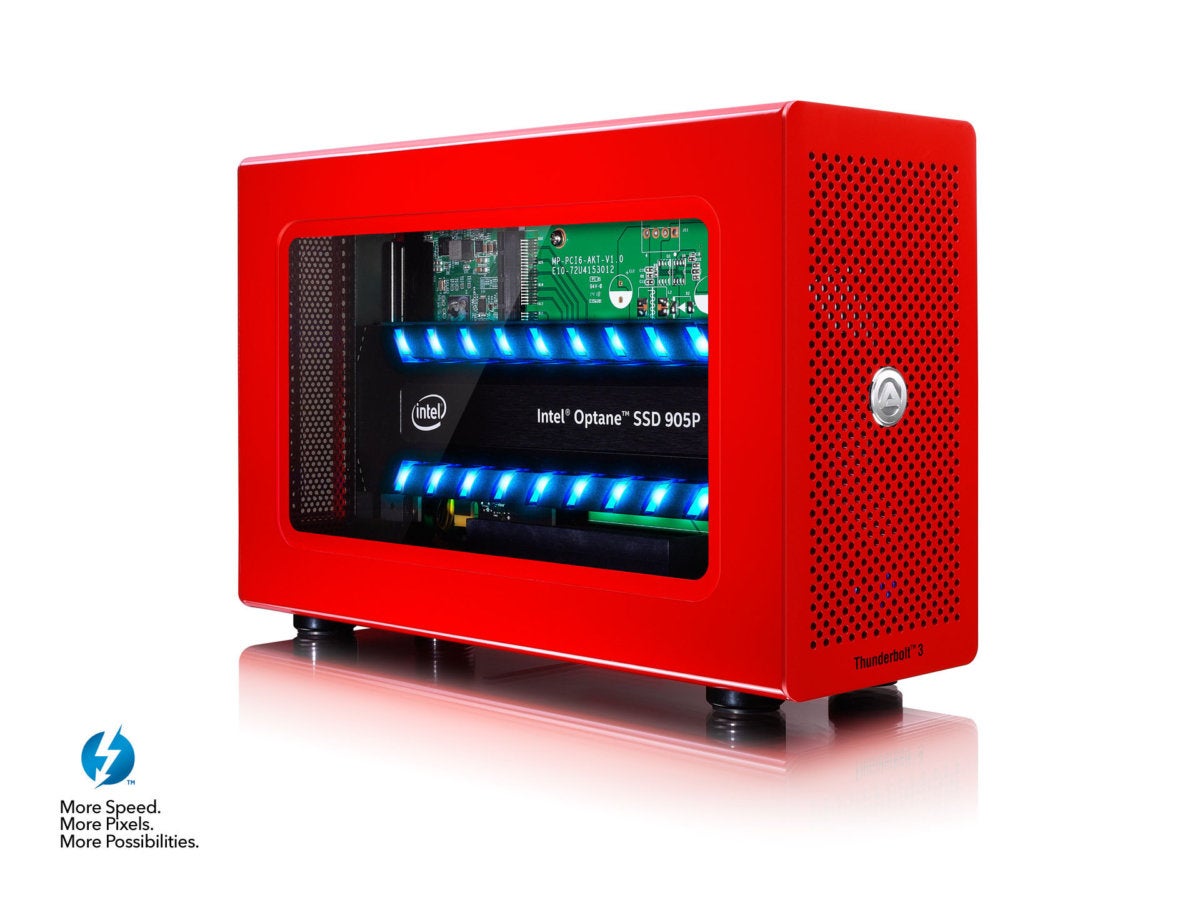 Akitio
 Note that the 905P's lighting is blue. We like the jazz group, but if incompatible colors bug you….
There is a plain brushed-silver version of the Node Fat-free, but this one is a limited design in bright fire-engine (or Corvette) red for deep-pocketed enthusiasts. It shows off the Light-emitting diode lighting on the Intel 905P via a windowpane on its left side. If you need to know more about Intel's uber-fast, super enduring and super pricey x4 PCIe card 905P NVMe SSD, you can understand about information technology here.
The enclosure uses captive thumbscrews to secure the extend, which slides forward and off. It tends to get hung up slenderly unless you joggle it a little.
Along the back of the physical body are two Thunderbolt 3/USB-C ports, a full-sized DisplayPort connective, and the Actinium jack. There's no power switch: The enclosure will mechanically act along operating room off when it senses current, or lack thereof, on the Thunderbolt bus.
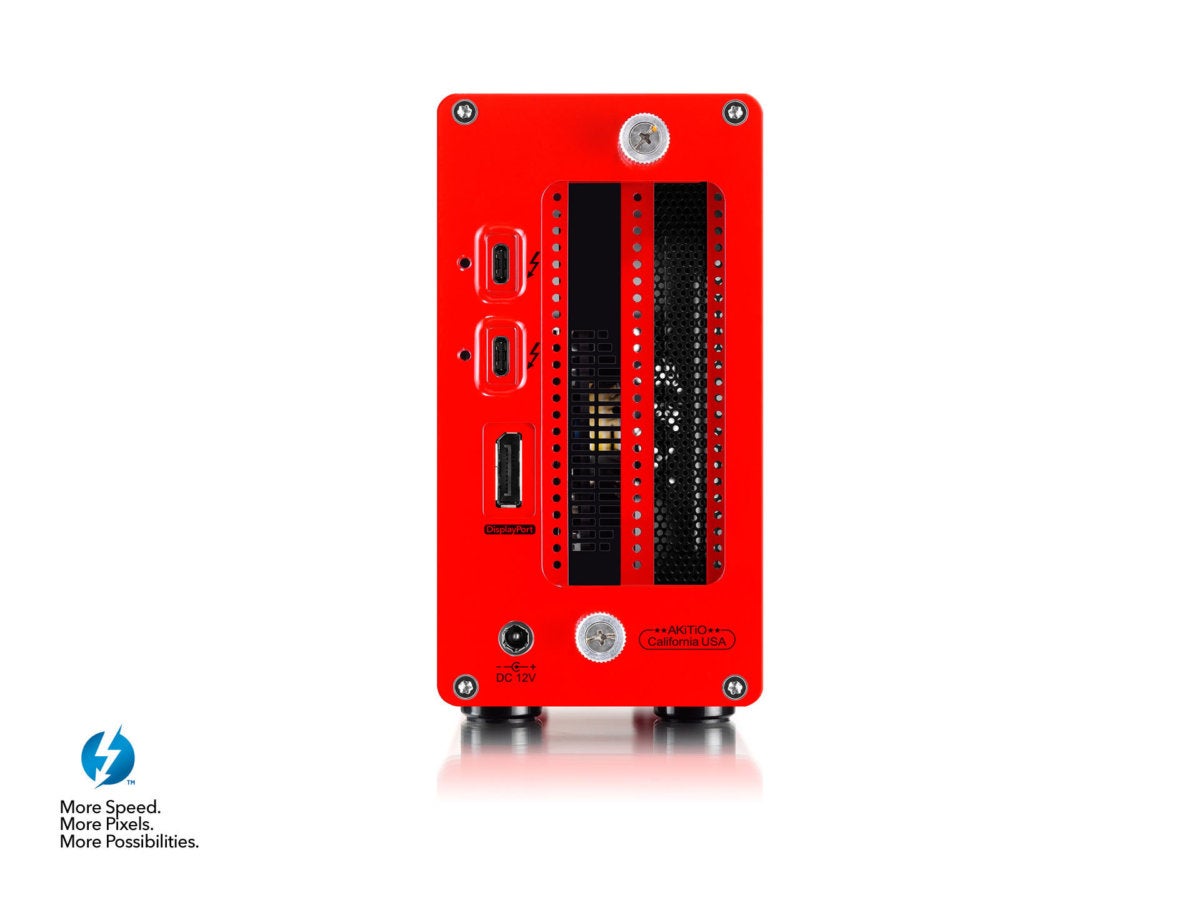 Akitio
 Cardinal Thunderbolt 3 ports, a single full-moderate-size DisplayPort port, and the power jack beautif the aft of the Guest Lite.
Inside is the aforesaid single stentorian-distance x16 PCIe slot. It's dainty that that the box accepts x16 cards, but Thunderbolt only supplies 4 lanes and we know of no mainstream NVMe thrust that uses to a higher degree that.
Cards are secure by screws at the top of the bracket, even as they are inside a total PC. Two thumbscrews are provided for wider cards, equal though those would most likely be, yes, graphics cards.
Performance
I tested the Node Lite (blue parallel bars) aboard a similar product from HighPoint, the 6661A. I "borrowed" the 905P for the latter, in addition to examination it internally in our storage test bed. The 905P was a bit slower in the enclosures than the drive in the test bed, but the performance of the two enclosures was so close that you can safely ignore it in your buy out conclusion.
The Samsung T5 is included in the charts below to illustrate the huge performance advantage Thunderbolt 3/NVMe holds over the USB 3.1 Gen 2/SATA. The latter, however, is far cheaper and universally compatible. Thunderbolt, unluckily, has barely made a gouge in the Windows populace.
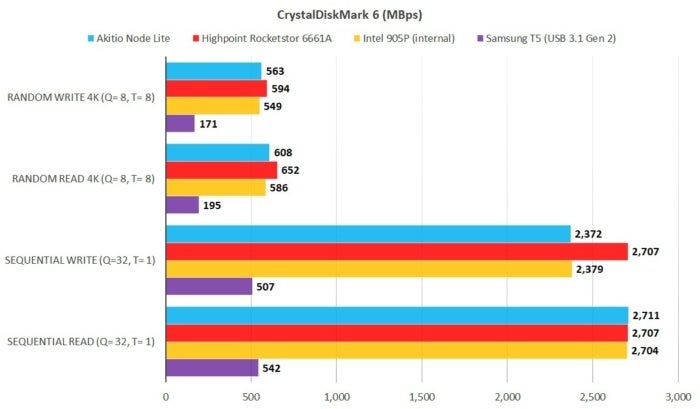 IDG
IDG The HighPoint 6661A was faster than the Node Lite (blue bars) in several CrystalDiskMark 6 tests, but the differences aren't noticeable in the real life. Still…Longer parallel bars are better.
USB 3.1 Gen 2 SATA seek times, as shown to a lower place, aren't slow. In point of fact, they're lightning-like (see what I did there?) compared to hard drives, but Thunderbolt 3/NVMe's are even faster.
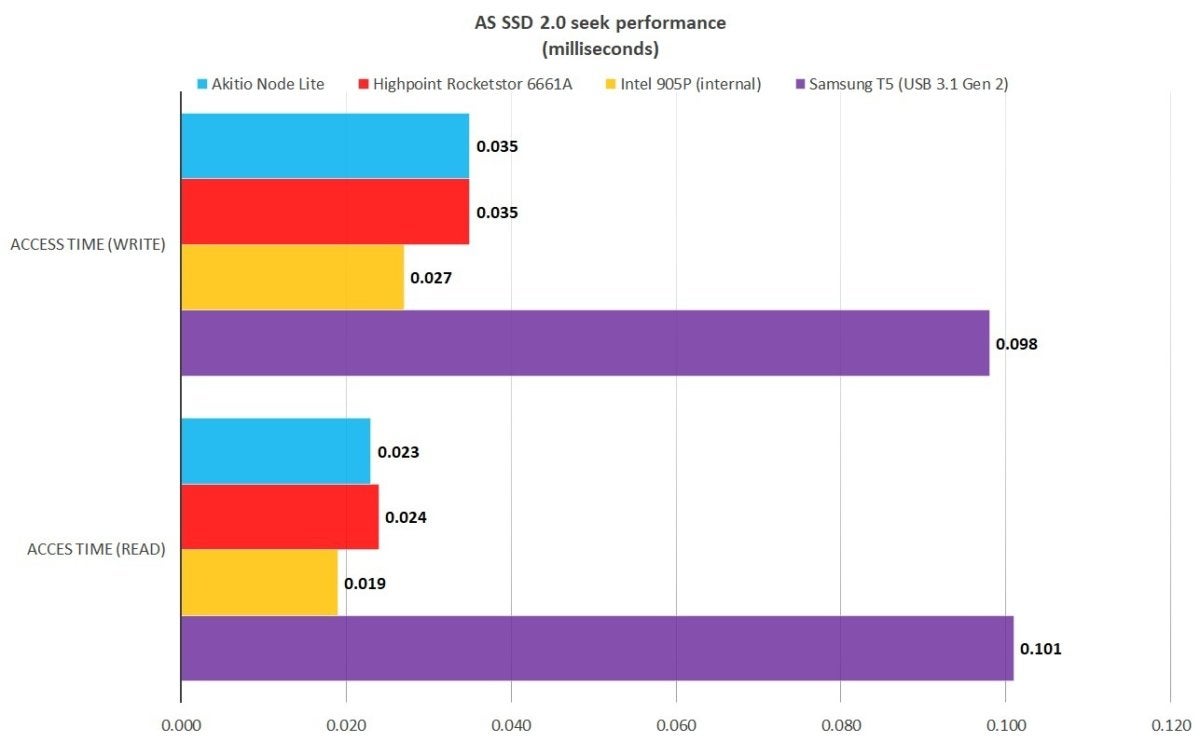 IDG
IDG You don't lose a lot of NVMe's fantastic seek multiplication by using Thunderbolt 3. Shorter parallel bars are best.
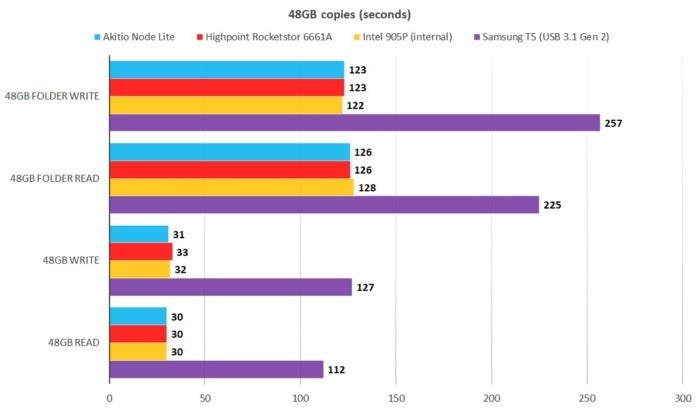
In that respect was little to take between the Akitio and the Highpoint, or for that matter the 905P operative in our testbed, in terms of the time it took to copy files.
 IDG
IDG The Node Calorie-free (patrician parallel bars) was faster in whatever tests, slower in others, but the differences were microscopical. Shorter bars are better.
In footing of performance, the Thickening Lite and the 6661A are a pick-'em. Both are well fast enough that you could run your OS from them and never placard the difference from an internal NVMe drive. Faithful enough, in fact, that your backups might be ended earlier you understand they've started.
 IDG
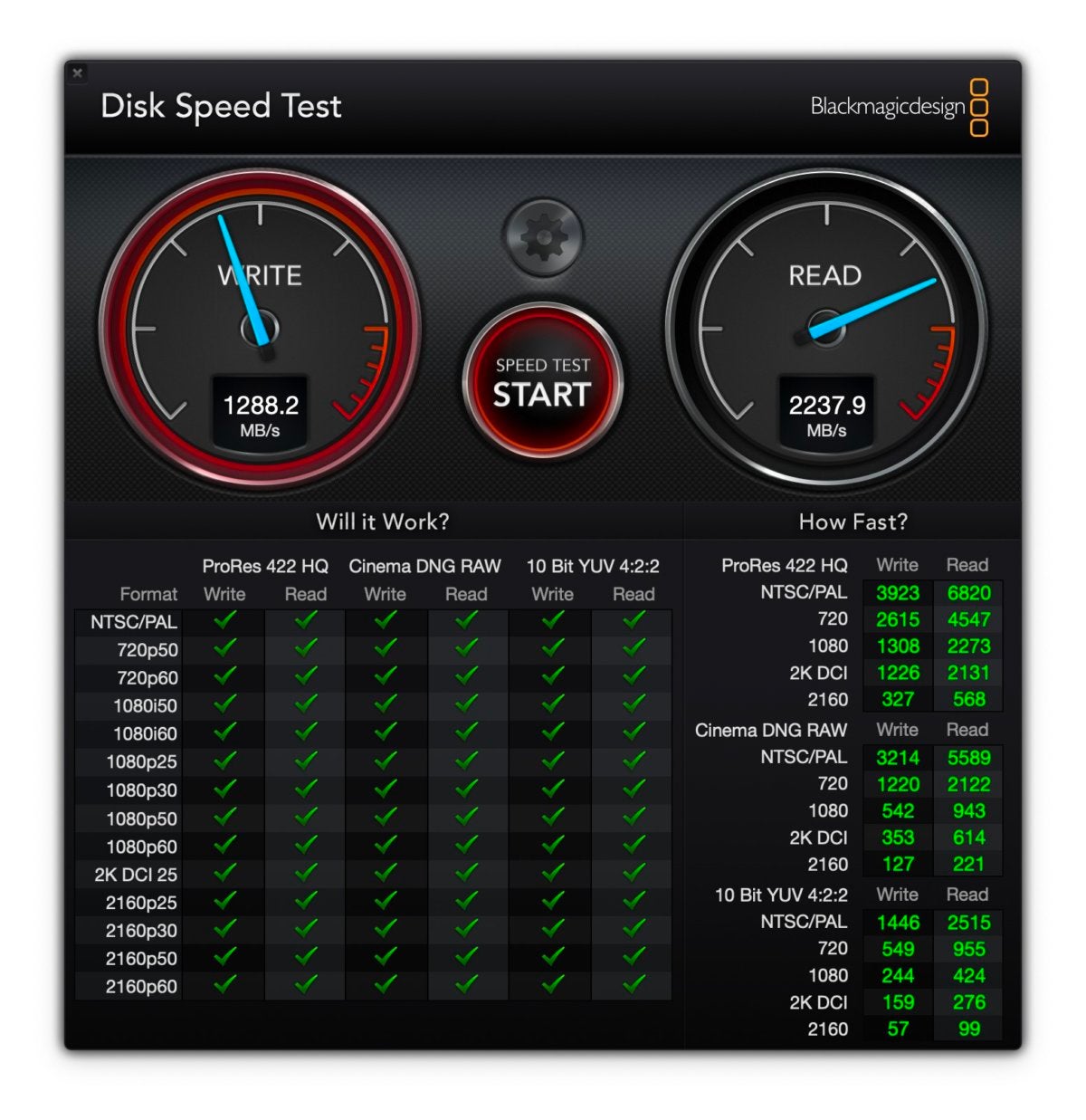
IDG Why the low write number on our 2017 Macbook Pro, we can't tell you, but the Node Lite is still very fast.
I as wel tested the Node Lite with Optane on a 2017 Macbook In favor. IT performed well, though we've seen higher write numbers racket. Intel's drives have had mild conflicts with Macs in front. See my article on NVMe over Thunderbolt in Macworld.
Note that you don't need to pay $1,500 for this case of performance, Samsung's 970 Pro (available via Amazon and reviewed here) and 970 EVO (for sale on Amazon and reviewed here), as well equally WD's Black NVMe (available on Amazon and reviewed here) are all viable, as well as far less expensive alternatives. You'll get the same kind of throughput, though slimly slower seeks and functioning with smaller files.
Conclusion
Though the Node Lite with Optane is expensive, its looks are a hoot, and the 905P is an superb performer with 10X the lifespan of NAND-based SSDs. There's also the dedicated DisplayPort port that the HighPoint RocketStor 6661A lacks. If money is no objective, it's grampus.
On the former hand, the plain Node Lite, and especially the 6661A with a cheaper drive inside, are more inside reach of the average exploiter.
Best Prices Nowadays
Not Available
Musical note: When you leverage something afterwards clicking links in our articles, we may take in a petite commission. Scan our assort data link policy for more details.
Jon is a Juilliard-trained musician, other x86/6800 programmer, and long-clock time (late 70s) computer partizan absolute in the San Francisco Bay region. jjacobi@pcworld.com

Source: https://www.pcworld.com/article/402862/akitio-node-lite-with-optane-review-thunderbolt-3.html
Posted by: bornofue1955.blogspot.com
0 Response to "Akitio Node Lite with Optane review: In-your-face Thunderbolt 3 performance - bornofue1955"
Post a Comment